Every week I read another post claiming that AI will replace Scrum Masters, Product Owners, Agile Coaches or even Agile itself.
I don’t think that’s what is happening.
AI is undoubtedly changing software development. Developers can generate code, create tests, explain unfamiliar code and automate repetitive work in minutes.
That is impressive.
But Agile has never been about writing code faster.
It has always been about discovering and delivering the right value.
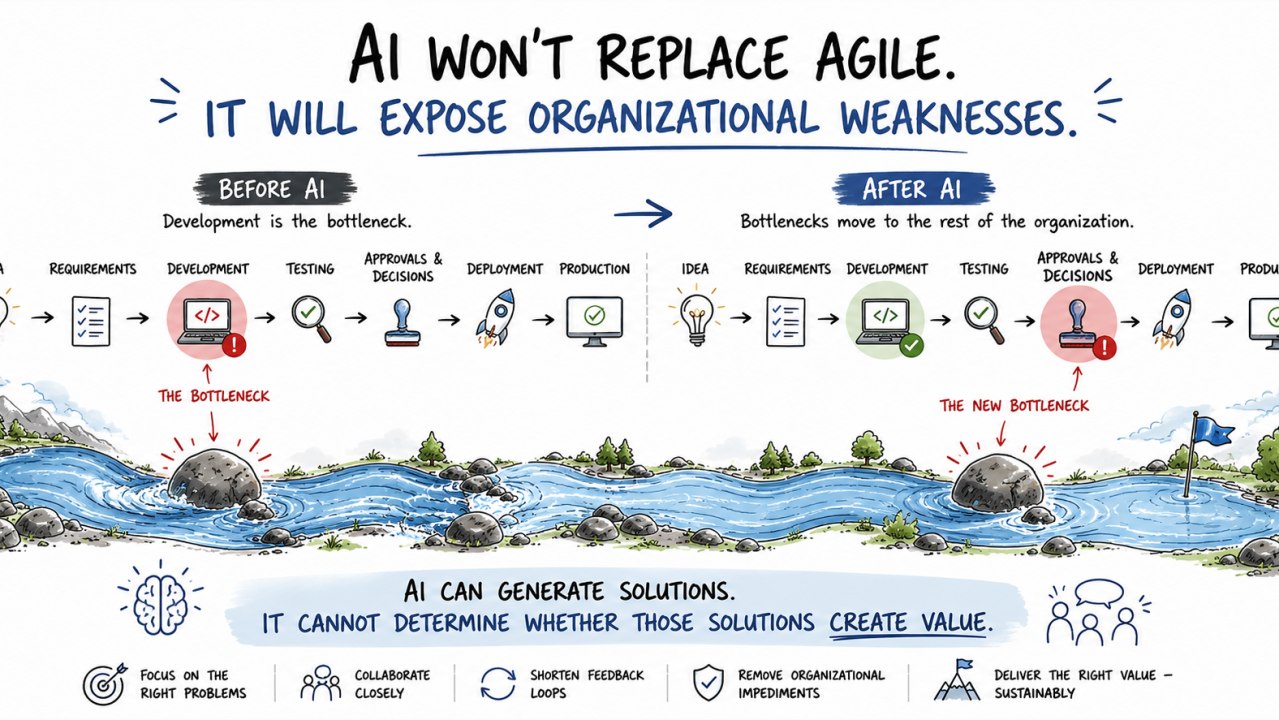
AI may help us build faster, but it doesn’t tell us whether we’re building the right thing.
Those are two very different challenges.
If AI allows teams to deliver software twice as fast while solving the wrong problem, speed becomes meaningless. Even when teams are building the right thing, testing, approvals, security reviews and decision making can quickly become the next bottleneck.
That is why I believe AI makes Agile more important, not less.
As development accelerates, understanding customer needs, shortening feedback loops and collaborating closely with stakeholders become even more important. AI can generate solutions. It cannot determine whether those solutions create value.
There is another challenge that deserves far more attention: responsible AI usage.
Experimenting with AI is important, but so is understanding what information you are sharing. Source code, architecture, customer data and strategic plans should never be entered into an AI tool without understanding the security, privacy and contractual implications.
Using AI effectively is not only about knowing what to ask.
It is also about knowing what not to share.
AI is also changing the skills we need.
The real value is increasingly found in asking better questions, validating AI generated output, challenging assumptions and making sound engineering and business decisions.
Critical thinking becomes more valuable, not less.
The same applies to Scrum Masters and Agile Coaches.
If our contribution is limited to facilitating events or reminding teams to update Jira, AI will automate part of that work.
But if we help teams understand customer needs, improve how they deliver value, remove organizational impediments and coach leaders, AI becomes another powerful tool instead of a replacement.
Before investing heavily in AI, every organization should ask itself one simple question.
Is our organization actually ready for AI?
That means looking beyond development speed.
Can business stakeholders make decisions quickly enough?
Can operations, security, compliance and testing keep up?
Can customers absorb new functionality at the same pace?
If the answer is no, AI may simply create work faster than the organization can process it.
Technology is rarely the biggest constraint.
Organizations are.
AI is transforming software development.
The biggest challenge is not whether AI can generate better code.
It is whether we can understand the right problems, deliver the right value and adapt our organizations as quickly as AI is changing the way we work.
That, to me, is why Agile still matters.